 I grant this work to the public domain.
 I finally decided to supplement my original article with a critique of a scholarly article among a list provided to me by a promoter of electromagnetic fear on Nextdoor.com, whom I was having a public online dialog with. Her list included a number of articles behind paywalls; however, I chose one of them that was open and available on sciencedirect.com:
The collision between wireless and biology, Paul Héroux, 20 May 2024, latest revision 9 May 2025
Before going into detail, I'll give my appraisal of the article as a whole. Having read it from beginning to end, I should have started at the end. If you start from the end, you see the assertion of a conspiracy theory, then going backwards, politics, then going backwards from that, confident assertions, then going back to the premises, many proposed physical/biological mechanisms phrased as "may" and "perhaps," not "will," then going back, an acknowledgment of the currently accepted basis for discounting biological harm. Thus, reading from beginning to end, he starts with gracious comments about current scientific and industry conclusions, and slowly develops it from his speculative ideas, then assuming them as fact, then toward politics and evil motives at the end.
The second observation is that he cites various mathematical equations of physics, yet does not actually apply them with quantitative data, or develop them further, or derive anything from them. This leaves me with the impression that he is citing them to bamboozle his audience. Otherwise, why cite them, if he is just discussing his ideas in a qualitative manner? That said, as far as I'm concerned, his being able to cite these equations means that he is without excuse if his application of the principles is fallacious. In other words, on one hand, I couldt say that some of these lay people propagating electromagnetic fear may be genuinely concerned in their intentions and motivation, just misinformed or duped. But in the case of this author, I would not be able to grant him that allowance if he actually misapplies the science and knows better, or if he presumes to understand it but doesn't.
So, you see, this is not getting off to a very good start.
I'll break this review down according to his eighteen listed headings.
1. "Introduction." Well, I suppose he does hint at his end conclusion that "powerful financial interests" are at play. Then his Introduction concludes that the controversy over health effects has been "maintained for far longer than necessary." Well, I would say the same thing, except with the opposite conclusion, that people have been fretting about possible electromagnetic harm for far too long. But, this is just the short Introduction.
2. "Thinking based on energy." First of all, citing the IEEE (the Institute of Electrical and Electronic Engineers) with a single generalization as "claiming" something is definitely not to his advantage, as this is a massive, professional organization (which he later cites as having 450,000 members) that represents both science and engineering, under formidable auspices and heavily peer reviewed. To generalize such a broad and respectable organization as merely making a "claim" is both simplistic and ipse dixit. Then, it is patently false, since the IEEE as an institution has never made that claim.
Then he presents "Argument 1" and "Argument 2," which would be both a fallacy of hasty generalization and a straw man. There are other reasons, "arguments," to consider, as I will explain. Either he is intentionally ignoring them, or he is not qualified to discuss the subject due to being unfamiliar with them.
The rest of this section, and his citing of mathematical/physical equations, is irrelevant, since no technical person of either polarized conclusion is contemplating harm based on thermal heating anymore, only non-thermal effects, and any layman can demonstrate to himself that pressing a mobile phone up against the body doesn't cause any sensation of warmth, though that is about the maximum RF power (about 1-2 Watts) that someone can expose himself to from any source other than a conventional two-way radio. As I pointed out in my article, this is about the power of a flashlight bulb (and assuming you don't press the tiny incandescent or LED element onto your skin, but allow it to spread out a little bit from its source).
3., 4., and 5. all simply develop the above assertion further, explaining how "NTER" ("Non-Thermal Electromagnetic Radiation") is predicted to not affect living things.
6. "About argument 1" starts the suggestion that "targets" of "Reactive Oxygen Species (ROS)" present themselves to NTER.
7. "About argument 2" starts the suggestion that "electron transfers" and "electron and proton currents" over "hundreds of nanometers" (i.e. 0.000000N meters, millionths of an inch) provide a "target" for NTER.
Now, at this point I need to explain something about electromagnetic radiation as best as I can in layman's terms. If you put your finger or something on just one terminal of a 9V battery, one terminal of your 12V car battery, or even one terminal of a 120V live wire, nothing happens. Why? Unscrew the end cap of a flashlight, so as to disconnect the negative terminal of the battery inside while the positive terminal of the battery is still connected to the flashlight bulb, and the bulb will not light up. Why? Because an electrical current only flows through a conductor across a potential difference in voltage. Even if you walk across a rug and accumulate thousands of volts of static electric charge, that is to no effect until you touch something that would cause a current to flow, discharging you.
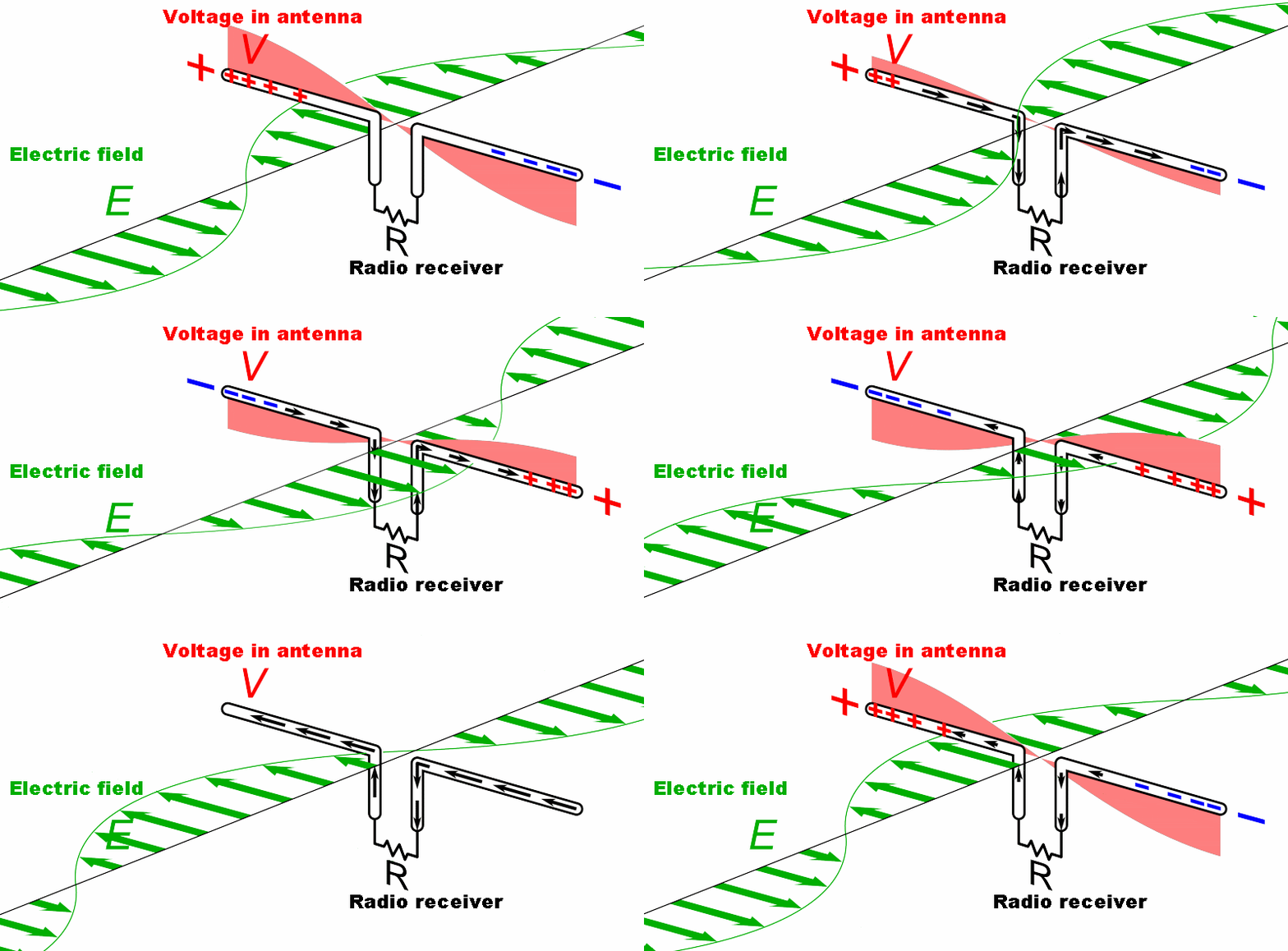
Look again at the visualization I posted in my original article of an antenna receiving an electromagnetic wave: http://www.wiebefamily.org/dipole_receiving_antenna_animation.gif
The conductor with the two arms is a dipole antenna. Its length is not arbitrary. To be resonant and generate an electric current, each arm is 1/4 the wavelength; together the antenna is 1/2 the wavelength. For the microwave frequencies of mobile phones and WiFi, etc, this wavelength would be on the order of a few inches, as I explained in my original article.
Resonance is easy to understand. If your child is in a swing and you are exerting a constant force on the child, the child does not move, but assumes some fixed position of equilibrium along the path of the swing. Conversely, if you push the child once a second, too fast, the swing does not move either. In acoustics, musical instruments, whether string instruments or wind instruments, operate by similar principles of resonance.
Now recall my illustration of a wave at sea in my original article. Suppose you have a monster wave that comes crashing upon a beach-side house. The force of it could damage the house (and I am talking now about the force of the wave, not mere water damage from flooding). But now imagine a bit of seaweed, an insect, or a seed riding on that wave. It is not affected by the wave, because it is too small. The wave would need to be of a wavelength on the order of the size of the seaweed, insect, or seed, for it to cause damage to it.
As I also explained, ionizing radiation is damaging because its wavelength is microscopic. But none of radio communications, even 5G "millimeter wave" frequencies, are microscopic.
Keep in mind that the author is talking about non-thermal effects. A 1000 Watt microwave oven does affect the water and other polar molecules at the molecular level, but only by altering their orientation as they try to line up with the electric field, and that increased kinetic energy expresses itself as increased heat. But their makeup and chemistry is not altered by the microwave radiation. And this is 1000 Watts in a microwave oven, not 10 Watts from a cell tower antenna (if you could climb up to the top of the tower and place your body in front of it), or 2 Watts from your mobile phone, or 1 Watt from a smart utility meter (only if you were to go out to the side of the house and press your body up against it). And certainly nothing from any of theses sources at any significant distance away.
This means that the author's ideas of effects of non-thermal electromagnetic radiation (NTER) at the frequencies of mobile phones and other common RF communication devices at the cellular, microscopic level are nullified simply because the effect at these wavelengths is negligible. These microscopic elements will just, obliviously, "ride the wave."
This principle serves to illustrate why the rest of his article is nonsense. If there is no potential difference of the electric field at a microscopic scale, then there is no corresponding energy to do any useful work, or have any useful effect, at a microscopic scale.
Let's look at it a slightly different way. To effect a chemical change, we need at least on the order of an electron volt, more typically substantially more, to ionize, to remove an electron from an atom or break a chemical bond. Now, to be generous to the opposition, we'll stick with 1 eV, one electron volt of excitation, making for easy calculation.
Let's calculate whether a microwave oven can do that.
E = hf, where h is Planck's constant, 4.136E-15 eV/Hz, so with 2.45 GHz, that would be 0.00001 electron volts, a hundred thousandth the energy level that would be needed to maybe effect a chemical change.
Now, granted, if you can heat the thing enough, the heat can cause a chemical change (i.e. burn you, cook you), for sure, but the radio waves, even at 1000 Watts inside a microwave oven, cannot do that. It doesn't matter how strong the electromagnetic field is. Even the 1000 Watts can't accomplish it. It does not matter whether it is a biological chemical bond. It is a chemical bond. The biology is constrained to this. You cannot say that the stuff of biology follows different laws of physics and chemistry. That is not even up for consideration if we are going to call it "science." So, there is no medical study to even contemplate, much less embark on.
Unless there is high enough heat generated. And 1000 Watts of microwave radiation at close range can give you a nasty burn, the same as a 1000 Watt stovetop element, for example.
Or unless it is ionizing radiation, which would have to be above that vicinity of 730,000 GHz, i.e. ultraviolet and beyond.
Again, consider the "dirty floor mat" illustration in my original article. You take the floor mat out to the porch, shake it vigorously, and dirt and dust fly off of it. Let's say that you are shaking it back and forth at a rate of ten times a second, or 10 Hz, to get that to happen. That would seem to me a reasonable estimate. Now let's do the order of magnitude comparison of, say, what will be an easy to calculate number for ultraviolet (ionizing) radiation ("UV-B") of 980,000 GHz. How slow is 2.45 GHz "microwave" radiation compared to that? Well, it is 980,000 ÷ 2.45 = 400,000 times slower. Now let's scale that down to the dirty floor mat. 10 Hz ÷ 400,000 = 0.000025 Hz, which would be waving the floor mat back and forth once every 40,000 seconds, meaning that you are going to take a little over 11 hours to wave the mat back and forth just one cycle. I'd say that anyone watching you do this would say you're nuts if you thought you would get any dirt off of it that way! Or maybe they will say that you are being ridiculously careful to keep from letting any dirt fall off of the mat! So, from my analogy, that 2.45 GHz would be a ridiculously careful way to make sure there are no chemical changes to your body!
Do you think this is the stuff of a doctoral dissertation or advanced engineering, chemistry, or physics? It is not. Actually, I thought to look to see if I could get this just from my son's high school physics textbook. I can. It has discussions of Plank's constant, E=hf, and electron shell energy/excitation levels. Now, of course, few if any of you remember your high school physics. But I am just saying that it was in there and you were taught this in high school physics, and at least qualitatively in high school chemistry, because I checked his chemistry textbook, too. So, what I am explaining is just a high school refresher. Then, going back to the discussions of frequency and wavelength of the electromagnetic spectrum, I verified that this was taught in my son's eighth grade physical science textbook.
All this is on top of the fact that the electric field strength is negligible at any appreciable distance in almost all scenarios, except perhaps for the 2 Watts of a mobile phone pushed up against the body.
Consequently, most of the rest of the article treats non-ionizing radiation as if it is ionizing.
So, back to section 7., the last paragraph makes a very ridiculous statement: "The energy-generating redox reactions embodied by OXPHOS provide continuous electron and proton flows over 150 nm distances that amplify the vulnerability of living tissues to environmental NTER: these currents are 200 times the size of those in simple redox reactions." Let that statement sink in. You have a 150 nm (0.00000015 meter) distance, which is negligible compared to the wavelength. Then you have "amplify the vulnerability" which is exactly the opposite of what the case is, as reducing distance reduces the "vulnerability," like the size of a "seed" of my analogy riding on the "monster wave" unaffected. Then he says that the "currents" of "environmental NTER" are "200 times the size of those in simple redox reactions" of living tissues, with no formulas, no math, no biological antenna or biological apparatus to form a radio receiver to produce an electric current inside living tissue such as to perturb anything at a microscopic or molecular scale.
Also in this section is a curious aside of his about "pulsed wireless communication" at the end of the paragraph previous to that. This assertion he makes without developing it at all! So, now we have an impetus for people not trained in the science to wave this banner of, "but the kind of radiation coming out of the new smart utility meters is pulsed, not continuous, and that is harmful."
So, now I have to address that proposition. Do you all remember broadcast AM radio, the oldest kind of radio broadcast there is, the one labeled "550 - 1600 kHz" on your old AM radio dial? That is pulsed. AM stands for "Amplitude Modulation," which means that the amplitude of the RF signal is what is varied exactly corresponding to the vibrations of the acoustic sound source being transmitted. If the sound source is zero (because there is no music or talking, or between syllables of speech), then the RF power is zero and cannot even be detected. The power varies with waves of the sound of the source. And in the other extreme, a tone at the high end of the audio spectrum, say, 20,000 Hz, is "pulsing" the RF signal 20,000 times a second! So, the whole thing is inherently not continuous, but "pulsed." Yes, that ancient AM radio broadcast, which, by the way, is being generated out of transmitting antennas routinely delivering up to 50,000 Watts of RF power! Not 10 Watts from a cell tower antenna, not 2 Watts from the mobile phone in your pocket, not 1 Watt from a smart meter on the side of your house.
Okay, done with the "pulsed" narrative, which is a red herring, and a case of either ignorance or academic dishonesty.
8. "Life reactions: metabolism, redox, ATP" is mostly some factual description of energy production in the body. Only the last paragraph is relevant here. It concludes the same fallacy as in section 7: "Because the process requires oxygen and phosphorylates ADP to ATP, it is named oxidative phosphorylation (OXPHOS). We will see below that OXPHOS is totally dependent on continuous currents of electrons and protons to maintain metabolism [11]. This implementation of metabolism, OXPHOS, magnifies the size of the target of interaction with NTER beyond the free radicals required by the Second Law." The "continuous currents of electrons and protons" is happening at a microscopic level. Again he repeats his phrase, "magnifies the target of interaction with NTER."
9. "Electron and proton paths in mitochondria" continues developing the idea. In subsection 9.1 see Fig. 1, and he says "100 nm in length" and "200 nm wide." He then jumps to an example of integrated circuit technology in electrical engineering, but this is hand-waving, as the biological systems that he is describing are neither similar nor analogous. Notice the grammatically subjunctive mood using the word "could" in "could find analogs in biological system." But he is guessing.
In 9.3, note the statement, "Although OXPHOS units are only hundreds of nanometers in size, an enormous number are scattered through the human body ('multiple input' for NTER)," and "the human body hosts quintillions of conductors hundreds of nanometers in size." But it does not matter how many of them there are scattered through the human body. Each one is a microscopic entity and has to be treated independently. In my illustration of a monster wave at sea, if there are a quintillion seeds riding upon the wave, none of them are more affected than if there were one. They are all independent. He ends the section in the last paragraph with the word "perhaps," saying, "perhaps leading to perturbations in the interactions of hydrated protein." In other words, he does not know.
10. "Where the environment perturbs metabolic currents" starts by mentioning Maxwell's equations, but is just getting at the principle of superposition, which is irrelevant. The section continues the fallacy of microscopic elements being affected by fields of comparatively massive wavelengths. He says regarding the (biological) field, that "this field will be perturbed by electromagnetic radiation coming from the outside, specifically by radiation emitted by a cell phone, network tower, or power system." He cannot quantify this, so this is a leap of logic from his "may" and "perhaps" statements from before, which he could not establish. And why those particular frequency bands? Are they the spooky ones, but not others? Yet now he adds "power system." Does he now think that 60 Hz will affect them? If so, why not the 50,000 Watt AM broadcast radio stations of 550 kHz to 1.6 MHz? And where was the outcry from that a century ago? Or the truckers' CB radios putting out 5 Watts at 27 MHz, over twice the power of a mobile phone and half the power of a cell tower antenna, right on top of their trucks?
But let's get back to the "principle of superposition," which he cites, and which is actually very intuitive and easy to explain. It just means that, at any particular point in space, or in the body, the electric field will be the sum of all the forces upon it. If you and three different people apply force to the same object, the force will be the sum of all your individual forces, and if someone is pushing in the opposite direction, then the forces will subtract, not add. Easy to understand, right? Well, let's go back to his phrase, "specifically by radiation emitted by a cell phone, network tower, or power system." No, you have to include all electromagnetic radiation at all frequencies. That electromagnetic "wave" coming from the AM radio station at 550 kHz, the one from the trucker on his CB radio at 27 MHz, the one from the FM radio station at 88 MHz, the ones from the WiFi at 2.4 and 5-6 GHz, mobile phones, cell towers, 5G "millimeter wave" antenna, infrared radiation, visible radiation, ultraviolet radiation, etc. all arithmetically combine, adding/subtracting from each other to produce a net electric/magnetic field at a point of space. The human body does not have a radio receiver apparatus to select one from another. That requires a specific electrical engineering design to do that. So, why, if he is going to mention Maxwell's equations and/or superposition, is he focused on some particular frequency bands, unless he is on an agenda against just radio devices transmitting within those particular bands?
11. "When the currents stop" is a simple discussion of the change in impedance (an electrical property) of living vs. dead flesh. That is all fine and good. He then takes a huge leap of faith in the final, short paragraph: "It is therefore not surprising that the effects of NTER would occur most obviously in the nervous system in animal models and in electromagnetically hypersensitive subjects." Here again, he uses the auxiliary verb, "would," subjunctive mood. So, it is an idea, not a conclusion. And he begs the question by proposing "hypersensitive subjects" without having shown how they could be "hypersensitive" in the first place. But wait! We have suddenly exited the realm of the microscopic and are now in the realm of the macroscopic. And so we are back to either thermal heating effects, muscles twitching, or, in the case of the brain, the risk of inducing convulsions, such as with electroconvulsive therapy (ECT), which is done with electrodes and applies voltages large enough to cause a sensation of electric shock, some 70 Volts up to hundreds of Volts, and currents up to close to 1 Ampere. Try even pressing the terminals of a 9-Volt battery against your head. You would need to press them against your wet tongue to have any sensation of that voltage, which would not persist after you pull the battery away from your tongue. Yet there is no such electromagnetic field from any legal radio transmitter that could cause such voltages or corresponding currents, nor is there any tuned antenna or radio receiver apparatus inside the body designed to do so, selecting certain frequencies over others. Remember from the last section, section 10, that "superposition" means that all frequencies of the whole spectrum combine at any given time and any given point of space. Your body does not have a tuned radio receiver inside of it.
12. "Crest factors, fields, and time" begins with a legitimate discussion of the difference between averaging power over time and taking into account pulsed signals. Your mobile phone, for example, will only briefly transmit only what message it needs to send to a cell tower or the internet, and that could be a small fraction of a second, after which it is not transmitting anything at all. So, he is right that we need to consider the signal only while it is transmitting, if only briefly. But then he again leaps from there, "just-so," ipse dixit, "Equation (8)," to conclude that "a wider range of physiological processes can be triggered." Again, in the next paragraph, he goes from the "wide Fourier transforms," which is correct, to, "just-so," ipse dixit, "enabling them to disturb biological steps with different resonances or transition times, some of which may combine synergistically," -- and note again the subjunctive "may" -- yet he has not yet demonstrated this pathology. Again, he is guessing. Then he mixes "toxicological concept," "Area Under the Curve," with that mathematical formula, except neglecting to represent it as a mathematical integral function (calculus).
I am not sure why he then speaks of pulses having such a low duty cycle as to not increase temperature. I suppose he is just suggesting that though you can't feel the heat, you can still be affected. But this is a red herring and non sequitur. We already observed that heat is not the issue, and that the most powerful radiated field, that from a mobile phone pressed up against the body, does not generate any discernible heat, even if the transmission is not infrequent, but constant, such as during a phone call or streaming video. So, why would we care about the same power level when it is infrequent?
13. "Shannon-Hartley theorem" restates the well-known relationship between usable data throughput and signal-to-noise ratio. That has nothing to do with the subject. But he mentions it because he wants to alert us to the ever-increasing need for higher frequency bands over time. Although he doesn't mention it, 5G millimeter wave bands are a good example of that, besides simply the need to find new, clear spectrum, whereas the current spectra are getting ever more crowded. Ah, but then, "just-so," ipse dixit, they "unavoidably imply larger NTER health impacts, even under conventional thermal and energy of activation thinking." Now, make sure you don't miss the sudden change from grammatical subjunctive to grammatical indicative. By using the word "unavoidably," all his speculative ideas and guesses have suddenly become fact. He then caps that off with a condescending shot, that "the analysis also pictures IEEE/ICNIRP views on NTER health effects as residing in the late 19th century." So, now, evidently, the IEEE has all the scholarship, know-how, and scientific/engineering knowledge of a scientist or engineer in the late 1800's? Actually, given what I have documented so far, of his fallacies, inconsistencies, and blaring omissions, he should take the plank out of his own eye before he insults the rest of the industry like that.
14. "Vulnerability of life to general radiation" takes that last statement of supposed fact, which suddenly came about after all the "may" and "perhaps," speculations. He now intertwines the legitimate dangers of ultraviolet, ionizing radiation, which is radiation with wavelengths of microscopic length, with "life's metabolism and design make it much more vulnerable to NTER..." where he is considering wavelengths that are inches in length. Yet he never demonstrated that NTER was an issue from all his speculation and guesswork suggestions. He never demonstrated that the effects of NTER were even "plausible." Increasing in subjectivity now, he says that "living systems have no defense against this new arrival." Then, in the last paragraph, he makes a curious new statement, "Even for static fields, adverse cardiovascular outcomes have been linked to changes of 10 nT, 0.03 % of the Earth's baseline." Is he really serious? That is a 0.00000001 T magnetic field, whereas people put their whole bodies in MRI scanners with up to 3 T magnetic fields in them (300 million times as powerful) which, as I showed in a photo and a video in my original article, can suck in and crush a lab cart or exert 2000 lb of force on an office chair. Yet there is no affect to the human body.
15. "Political history of NTER health effects" forms the conspiracy theory, which is that financial interests of industry squelch conclusions of adverse health effects, which health effects of NTER he now just assumes as fact. So, obviously, if it is fact, then he wants us to consider a conspiracy of industry financial interests. However, if it is not fact, then there is no basis for the conspiracy theory.
16. "Biological consequences" hand-waves about hundreds of studies that supposedly confirm what he says. We don't have the time to read hundreds of more articles. He has had the opportunity to present his theory in this one article and failed. If there was additional wisdom in these other hundreds of articles, then why didn't he use any of them in his article to prove his case? He appears to have a good grasp on the biology, and some grasp on the physics, though it is obvious to me that he is more than a little bit green there, and has overlooked some obvious things, as I have pointed out. The "general scientific literature," as represented by the IEEE, the U.S. FDA, the U.S. FCC, the U.S. EPA, the U.S. CPSC, the NIH, the CDC, the WHO, and other national and international organizations, both scientific and regulatory, has concluded that there are no effects from NTER from sources at the power levels of mobile phones, cell towers, and such. Particularly, the regulatory organizations are not pro-industry, but inherently restrict unrestrained industry interests, restraining them without any regard to the cost or consequences to the industry. The industry, in turn, simply lives with these restrictions and passes on increased costs of regulation to the consumer. This is where his conspiracy theory breaks down, in that the "they" include the regulators, who are no friends of the industry. Sure, the industry has powerful financial interests. But the regulatory agencies have no sympathy for them. If anything, more often than not, we have seen these regulatory agencies over-regulate, usually in order to cover worst-case scenarios of application, but also just legalistically. There is no allowance or sympathy for either the general public or the industry there, no exceptions to the regulations, no mercy, no forgiveness.
I remember a co-worker telling me a story of the former super-computer company called Thinking Machines here in Boston. Evidently, their engineering lab was on or near the top floor of their building in Boston, and when we as engineers would design and develop computer hardware, we would put our development system in large, open frames on the lab benches to make it so that we could test and debug them with our lab instrumentation. But that means that these open frames would be spewing electromagnetic radiation out, unhindered by the proper product enclosure that they were destined to be in as a salable, shippable product. Well, evidently these guys on the top floor were right under the traffic path of incoming flights into Logan Airport, which would be flying pretty low over the Boston skyline, since the airport was right there. The aircraft coming in kept dropping the ILS (Instrument Landing System) signal on approach to Logan. There were no aviation incidents, as pilots can obviously take over the controls manually and need not rely on ILS, and of course the dropout would have been very brief anyway. But the FAA reported the issue to the FCC for investigation, and the FCC immediately found the source. Their response was swift. The FCC came out to the building with federal marshals, confronted the receptionist in the lobby, and asked to be taken to the location of the main circuit breaker for the entire building. They went down, pulled the main breaker, and put a lock on it. Everything went black for the whole building and the building was without power for weeks or months, until the company could prove to the FCC that they had reduced the radiated emissions, with the FCC inspectors onsite, watching them power things up again little by little in sight of the watchful eye of the FCC agents and the agents' monitoring equipment. That is how serious regulatory agencies are.
These regulatory agencies even go so far as to create regulations that are precautionary and not based on actual demonstrated effects or incidents. For example, the FAA requires mobile phones to be in "airplane mode," shutting down all cellular/WiFi/Bluetooth radio transmissions during an entire flight. This is despite that there has never been an aviation incident and that modern equipment is designed to be robust enough to be not affected by such low-level RF emissions and interference. The reason for the regulation is speculative, that some, much older, dated aviation radio equipment, in theory, might not have sufficient selectivity, so could be affected, and aircraft, unlike automobiles, can be well over a half century old yet still maintained and routinely flown. The most I have heard are some anecdotal reports by commercial airline pilots who say that they hear an annoying, low-level buzzing in their radios from what they say is all the so many passengers ignoring the "airplane mode" directive and using their mobile phones, and I think that perhaps could be plausible (now note my grammatical subjunctive) inside the metal tube of a large, commercial aircraft full of passengers. But that is anecdotal, and my point here is that it is irrelevant. The airline must obey the FAA regulation, and if you refuse to obey the corresponding directive of the flight crew, you will be kicked off the flight, and if the airline is found to not enforce the FAA regulations, it will lose its FAA operating certificate, grounding all its aircraft, and if the airline goes out of business, the FAA does not care.
In another, more relevant example, the FCC has established an SAR (Specific Absorption Rate) for mobile telephones. It is 1.6 Watts per kilogram. Again, this is precautionary and not based upon any theory or actual incidents. Certainly, if it was 1000 Watts, like a microwave oven, it would heat and burn someone's flesh, but a limit was established with plenty of margin such that the regulatory agencies could assure themselves that there could be no effect. The cell phone companies must verify this 1.6 Watts per kilogram with a mannequin filled with a liquid or other material that mimics human flesh. If the test fails, the cell phone company cannot sell the phone. Period. Again, the FCC does not care how much money the industry loses as a result of such regulation, or that as a consequence it limits your range in reaching the nearest cell tower, which a phone manufacturer could enhance by increasing the RF power output. That SAR limit is fundamentally precautionary, yet nonnegotiable.
I will also mention, since I happened to write an article about it, the 2016 fiasco with the Samsung Galaxy Note 7. You all probably remember it. The U.S. CPSC (Consumer Product Safety Commission) mandated a complete recall of the millions of smartphones sold, and Samsung lost the entire investment in that smartphone, which cost them many billions of dollars (I read "$5.3 billion" lost, short term, and "$17 billion" in potential revenue, long term). The regulatory agencies do not care. And the combination of regulatory oversight and public perception affected by the news media make it so that any legitimate threat to public health and safety will have a profound financial impact to the industry, sometimes even disproportional to the threat, as I pointed out in that article. And note I said "legitimate threat." The radiation from mobile phones, WiFi, utility smart meters, cell phone towers, and etc. is not a "legitimate threat."
So much for the "industry financial interest" conspiracy theory. The industry simply does not operate without substantial, including precautionary, regulatory oversight, and if an industry player does not heed the regulations, even for those that are clearly precautionary, that industry player will go out of business, and the regulatory agencies do not care.
17. "Health consequences" now continues with the "just-so," ipse dixit assertions that he did not demonstrate in his article, but now it gets wild. Leukemia, other cancer, nervous system effects, "wider variety of daughter cancer cells" due to "a fluctuating level of ATP production," tumor seeds made more malignant, Parkinson's, Alzheimer's, diabetes due to "NTER as an endocrine disruptor," altered pH and ROS levels, "impaired binding of insulin to the GLU4 receptor," reproductive hazards, worldwide decrease in fertility and, in 17.1, irreversible consequences.
18. "Conclusion" simply continues the author's insistence of damaging effects, all in the grammatical indicative, such as "oscillating electric or magnetic fields penetrating from the environment will alter the tissue's electron and proton currents." Then another player is added to the conspiracy theory: The military. But this is also a red herring. Yet it serves the final statement for shock value: "If your environment is made to mimic a theater of war, it will not be a theater of health."
Finally, there is a curious concessionary statement, that the paper "ignores characteristics of common carrier modulations such as GSM and LTE, believed to be of importance in determining health impacts." "Believed" by whom? Him? Yet GSM and LTE are not "carrier modulations." Those are data protocols and spectrum allocations. So, this is just silly. There he throws in another grammatical subjunctive, "may" to the "just so," ipse dixit assertions, again just hand-waving, "new modulation schemes capable of reducing major health effects," which both has nothing to do with the electromagnetic fields even if they were to have an effect, and is doubly irrelevant, since they do not have an effect.
And the paper is done.
The "Authors' information" heading states, "The author is professor of Toxicology and Health Effects of Electromagnetism at McGill University. He serves as Vice-President and Commissioner of the International Commission on the Biological Effects of Electromagnetic Fields." This is very significant in that this assures me that I have now critiqued a scientific paper of among the most respected and qualified individuals to claim biological effects. He has indeed bridged the physics with proposed pathways of a biochemical and electrochemical nature. Since this is both his specialty and he is part of an international commission of like concern, I think we are assured that he would not leave anything out of consideration that has been considered within an international community of concerned individuals. In other words, he would not be ignorant of other, more viable pathways proposed by others, to which he might have been unaware. That scenario is ruled out. We are viewing a representative of the "state of the art," so to speak, of proposed biological harm. Indeed, he cites no less than 93 external reference works at the end of his paper. There is no more authoritative source to consider or critique, so that means that I have done my due diligence to take into account the views and arguments of the opposition. The article is dated, last revision, May 9, 2025, so it cannot be said to be relying on outdated information.
I grant this work to the public domain.